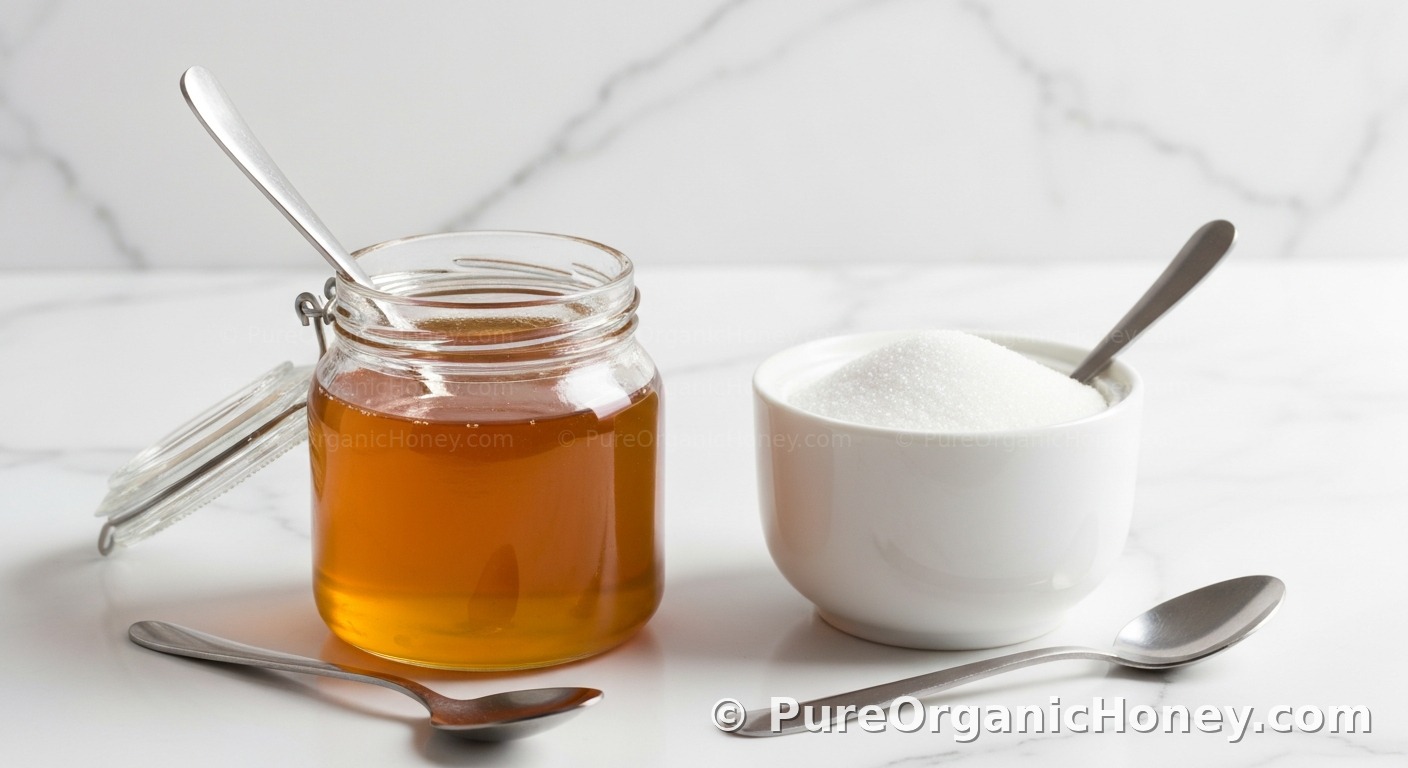
You’re trying to eat healthier, so you reach for honey instead of sugar. It’s natural, after all—it must be better for you, right? The honey vs sugar debate is more complicated than it seems. Yes, honey has some advantages over refined sugar. But it’s not a health food, and swapping sugar for honey won’t transform your diet.
The Basics: What Are We Comparing?
Table sugar (sucrose) is refined from sugarcane or sugar beets. It’s pure sucrose—50% glucose and 50% fructose bonded together. Processing removes everything except pure sucrose, resulting in a consistent product with no nutritional value beyond calories. Honey is produced by bees from flower nectar: approximately 40% fructose, 30% glucose, 17% water, and 13% other compounds including enzymes, antioxidants, vitamins, and minerals. The level of processing varies—raw honey retains far more of these compounds than pasteurized honey.
Nutritional Comparison
| Factor | Honey (per tbsp) | Sugar (per tbsp) |
|---|---|---|
| Calories | 64 | 48 |
| Carbohydrates | 17g | 12.5g |
| Glycemic Index | ~58 | ~65 |
| Vitamins & minerals | Trace amounts | None |
| Antioxidants | Yes (raw honey) | No |
| Enzymes | Yes (raw honey) | No |
Surprise: Honey actually has more calories per tablespoon than sugar. However, honey is sweeter, so you typically use less to achieve the same sweetness—which can offset the calorie difference in practice.
Where Honey Genuinely Wins
Antioxidants: Raw honey contains flavonoids and polyphenols—compounds with real health benefits. Sugar has none. Darker honeys (buckwheat, manuka) have the highest antioxidant content. Lower glycemic index: Honey’s GI of around 58 is modestly lower than sugar’s 65, meaning it raises blood sugar slightly more slowly. Trace nutrients: Honey contains small amounts of vitamins B6, C, riboflavin, calcium, potassium, and magnesium. The amounts are small but sugar has literally zero. Antibacterial properties: Raw honey has well-documented antibacterial properties useful for wound care and sore throat relief—something sugar cannot offer.
Where Sugar Has the Edge
Fewer calories per tablespoon: If you use equal quantities, sugar has fewer calories. Neutral flavor: Sugar doesn’t change the flavor of recipes. Lower cost: Sugar is significantly cheaper than quality raw honey. Baking performance: Sugar behaves more predictably in baking—honey adds moisture and can change texture significantly.
The Bottom Line
Both honey and sugar are primarily sugar and should be consumed in moderation. Honey has a modest nutritional edge over refined sugar—especially raw honey, which retains antioxidants and enzymes. But neither is a health food, and neither should be consumed freely. The best approach: use whichever you enjoy in reasonable amounts, and focus most of your diet on whole foods where the sugar debate becomes irrelevant.
Frequently Asked Questions
Is honey better than sugar for weight loss?
Not significantly. Honey has more calories per tablespoon. If you use less honey due to its sweetness, total calories may be similar or slightly lower. Neither is a weight loss food.
Can I substitute honey for sugar in baking?
Yes, but with adjustments. Use ¾ cup honey for every 1 cup sugar. Reduce other liquids by ¼ cup. Add ¼ teaspoon baking soda to neutralize honey’s acidity. Reduce oven temperature by 25°F as honey browns faster.
Is honey better for diabetics than sugar?
Marginally, due to a slightly lower glycemic index. But both significantly raise blood sugar and must be counted as carbohydrates. Neither is freely consumed by people with diabetes.
Disclaimer: This article is for informational purposes only. For personalized dietary advice, consult a registered dietitian or healthcare provider.