
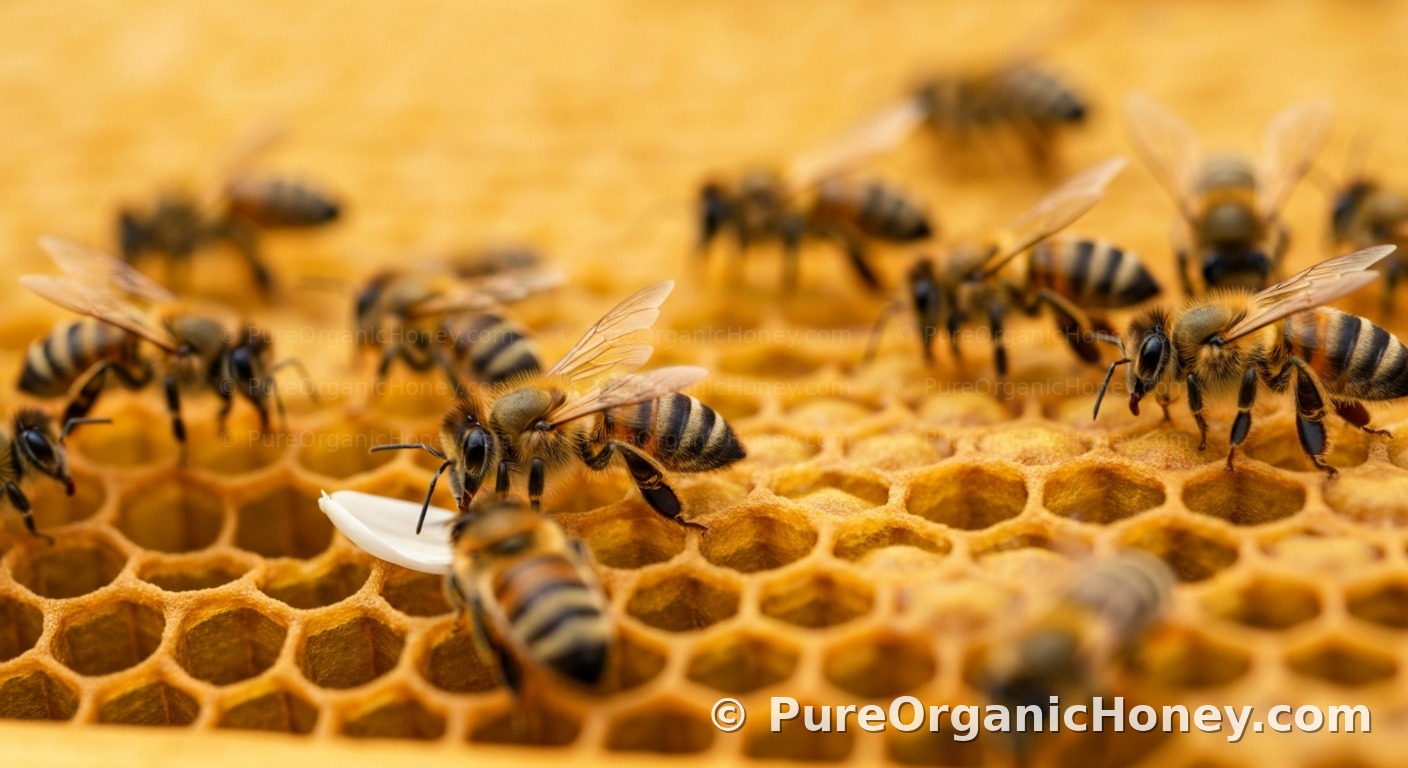
A single jar of honey represents an incredible journey—one involving thousands of bees, millions of flowers, and a process so sophisticated that scientists still study it today. How is honey made? The short answer: bees collect flower nectar and transform it through enzymatic action and evaporation. But the full story is far more fascinating.
Step 1: Foraging — Collecting Nectar
The process begins with forager bees—specialized workers whose job is finding and collecting nectar from flowers. Nectar is a sugary liquid produced by flowers to attract pollinators—primarily water (70–80%) mixed with sugars. Different flowers produce different nectars, which is why clover honey tastes different from wildflower or orange blossom honey.
When a forager finds a good nectar source, she returns to the hive and performs the famous waggle dance—a figure-eight movement that communicates the direction and distance of the flowers to other bees. She uses her long proboscis (tongue) to suck up nectar into her honey stomach—a special storage pouch separate from her digestive system.
The Math of Honey Production
- To produce 1 pound of honey, bees must visit approximately 2 million flowers
- Foragers collectively fly about 55,000 miles—more than twice around the Earth
- It takes the lifetime work of approximately 556 worker bees
- A single bee produces only about 1/12 teaspoon of honey in her entire life
Step 2: Enzymatic Transformation
During the flight back to the hive, enzymes in the bee’s honey stomach begin transforming the nectar. The enzyme invertase splits sucrose into simpler sugars—glucose and fructose. Another enzyme, glucose oxidase, begins producing small amounts of hydrogen peroxide, which will give honey its antibacterial properties.
Step 3: The Bee-to-Bee Transfer
Back at the hive, the forager passes her nectar load to a house bee through trophallaxis—essentially mouth-to-mouth transfer. The house bee chews the nectar for about 30 minutes, mixing it with more enzymes and beginning to reduce its water content. She may pass it to another bee, who repeats the process. The nectar may pass through 10–20 bees before reaching storage, with each transfer adding enzymes and reducing water content.
Step 4: Dehydration — Removing the Water
Nectar is 70–80% water. Finished honey is only 17–18% water. Getting rid of that moisture is essential—if honey retained too much water, it would ferment. Bees accomplish this through two methods: spreading thin films of nectar across honeycomb cells to maximize evaporation surface area, and fanning—worker bees beat their wings up to 200 times per second, creating air currents that move humid air out of the hive. This process continues until moisture drops below 18%.
Step 5: Capping — Sealing the Honey
Once honey reaches the right moisture content, bees seal each cell with a thin layer of beeswax—the wax cap. This natural seal protects the honey from air and moisture, preserving it indefinitely. Capped honey is the sign beekeepers look for before harvesting—it means the bees have finished the job.
Step 6: Harvesting
Beekeepers remove honeycomb frames from the hive, uncap the wax using a heated knife or fork, and spin the frames in a centrifuge to extract honey by centrifugal force. The raw honey is then strained to remove wax and debris, and either bottled as raw honey or sent for further processing (heating, ultra-filtration) to become commercial honey.
Frequently Asked Questions
How long does it take bees to make honey?
A hive can produce about 2–3 pounds of honey per day during peak summer foraging. A full honey super (storage box) typically takes 1–3 weeks to fill, depending on nectar availability and hive strength.
Why does honey from different flowers taste different?
Each flower produces nectar with a unique sugar composition and trace compounds. These differences carry through the process, giving clover honey its mild sweetness, buckwheat its robust earthiness, and orange blossom its floral lightness.
How many bees live in a hive?
A healthy hive contains 40,000–80,000 bees during peak summer season: one queen, a few hundred male drones, and tens of thousands of female workers who do all the foraging, processing, and hive maintenance.
Disclaimer: This article is for educational purposes only.